
BY JUDITH DUNLOP | OWNER AND FOUNDER OF SCOTTISH SEASIDE SAUNAS
Growth in Saunas In Scotland
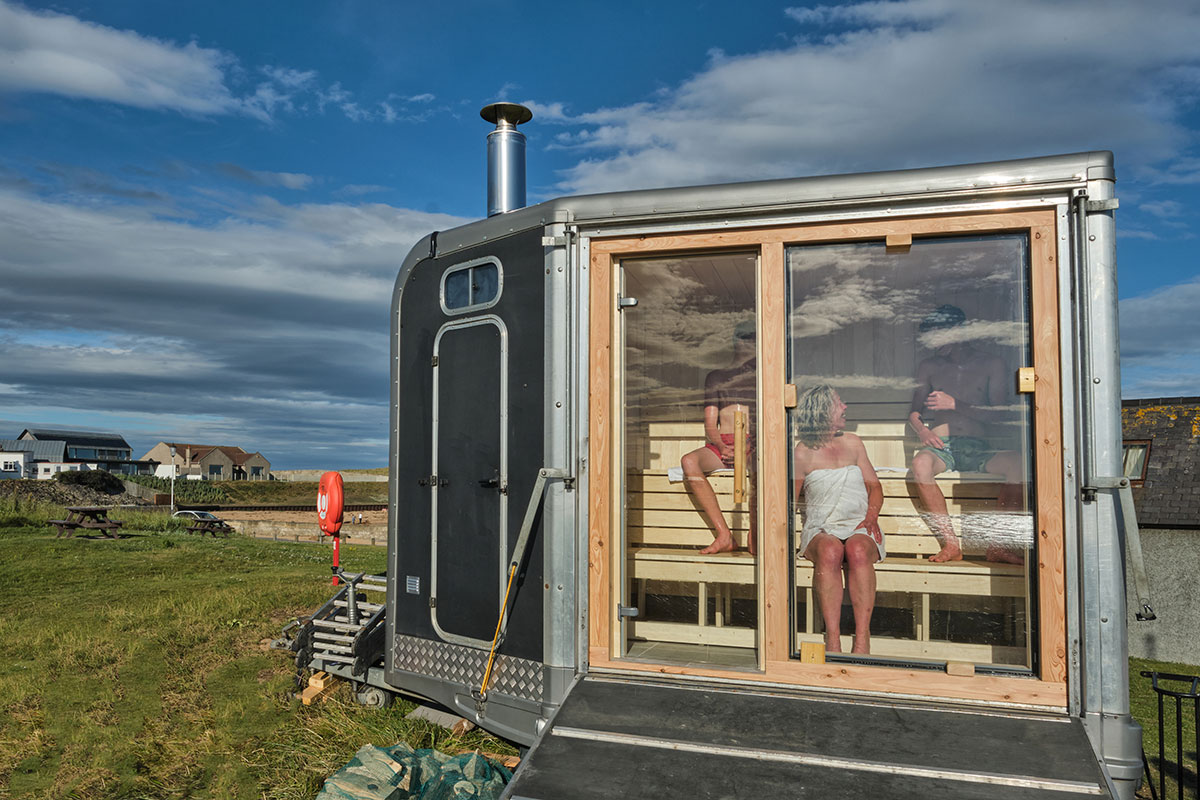
As the founder and director of Scottish Seaside Saunas, I’ve had the privilege of watching outdoor sauna culture grow from a novel curiosity, into a meaningtul part of Scotland’s cultural landscape . When I first conceived of opening an outdoor sauna on Elie Harbour, in my home village of Elie, in The East Neuk of Scotland, during lockdown 2021, I knew of no one else doing such a think in The UK. I, then, discovered Beach Box, Brighton and The British Sauna Society, which I joined in early 2022.
So, when The Original Elie Seaside Sauna, arrived on Elie Harbour, exactly 4 years ago, in June 2022, there were no other publicly
available outdoor saunas in Scotland. As I anticipated, us Scots adapted to the concept, quickly and what started with this small seaside sauna, in a converted horse trailer has evolved into a movement, one that now calls for structure, responsibility,
and shared standards.
In the past year I have seen a very rapid growth. One that reminds me of the gin boom of previous decades, with very many people opening very similar saunas, in very many places. This process is aided by a similar growth in companies making ease of entry easier by importing and supplying low cost barrel saunas, for example, to those looking to establish a business operation, quickly, alongside those
building their own, or starting with horse trailer conversions.
With that growth comes a question we can no longer afford to ignore:
How do we ensure that outdoor sauna experiences across Scotland are safe, authentic, and of consistently high quality?
Why Standards Matter
Now Outdoor saunas operate in a unique space. We are not quite hospitality, not quite wellness, and not quite leisure but we borrow elements from all three. This makes regulation complex, and in many cases, inconsistent.
Without clear, agreed standards, we risk three things:
• Compromising safety, particularly around heat exposure, fire management, and
sea access.
• Diluting the cultural integrity of sauna practice, especially where traditions are
misunderstood or misrepresented.
• Undermining public trust in what should be a deeply beneficial and restorative
experience.
Establishing standards is not about restricting creativity, or independence. It is about creating a shared foundation that protects both operators and guests, while elevating the industry as a whole.
Training as the Cornerstone
At the heart of any meaningful standard is training. Not just a one-size-fits-all approach, but a structured pathway that reflects the different roles within sauna operations. From my perspective, there are three essential levels of training thatScotland’s outdoor sauna sector should begin to formalise.
Sauna Hosts and New Operators
This is the foundation of the entire experience. Sauna hosts are often the first point of contact and the guardians of safety on site.
Training at this level should include:
• Core health and safety principles, including heat exposure awareness and
emergency response.
• Fire safety and stove management, an understanding of the principles of sauna
design and architecture and how this impacts on safety.
• Guest communication and etiquette.
• Basic understanding of sauna culture and best practice.
• Environmental responsibility, particularly in coastland sensitive locations.
For new operators, this level also needs to extend into site management, risk assessment, and regulatory awareness. A well-run sauna begins long before the first guest steps inside.
Sauna Ritual guides
Guided sauna experiences, whether through steam (löyly), aromatics, or structured sessions are becoming increasingly popular. Done well, they can transform a simple sauna into something memorable and deeply restorative. Many people, in Scotland, see others working with whisks and aromas, in saunas, on social media. They are so hungry for similar experiences, without regard for appropriate practice, or sauna traditions, are they are quite literally, making things up, or copying what they see on social media.
In such instances, what they are doing becomes a performance, rather than anything delivered with humility, respect for the practices, or the sauna guests. Therefore, there is a desperate need tor good quality training, delivered by sauna practitioners, who themselves have gone through extensive training, practice with humility and are embedded in traditional practices. Training for ritual guides should include:
• Understanding of heat dynamics and safe steam application.
• Appropriate and safe use of natural materials such as essential oils and
botanicals.
• Group management and pacing of sessions.
• Awareness of guest limits and contraindications.
• Cultural context, ensuring practices are respectful and not superficial adaptations. This level is where craft begins to meet care. It requires both technical knowledge and sensitivity to the group experience.
Sauna Masters
At the highest level are those who not only deliver exceptional sauna experiences, but shape the culture itself.
A Sauna Master should embody:
• Advanced technical understanding of heat, airflow, and stove operation.
• Mastery of ritual techniques and performance.
• The ability to train and mentor others.
• A strong grounding in sauna heritage, particularly Nordic and/or Baltic traditions and an understanding of their own, immediate environment and how they can create rituals that bring in a sense of place.
• Leadership in upholding standards and contributing to the wider sauna
community.
This level is not simply about skill, but about stewardship. Sauna Masters play a key role in defining what excellence looks like in Scotland’s evolving sauna culture. Becoming a sauna master is a process, that evolves over time. An ongoing practice of learning. Becoming a sauna master, is not something that is delivered in a few days training, on an unaccredited course, delivered by someone who themselves has had limited training. It is also something that, I believe, requires a high degree of humility, a respect for tradition and of others and a distinct lack of ego.
A Collective Responsibility
If Scotland is to become a respected destination for outdoor sauna, we need to move forward together. Operators, practitioners, and industry bodies all have a role to play in shaping a framework that is both robust and adaptable.
Training is the starting point. It is how we pass on knowledge, embed good practice,and ensure that growth does not come at the expense of quality or safety. At Scottish Seaside Saunas, we have always believed that sauna is more than heat, it is about connection, community, sustainability, accessibility, environment, and care.
Establishing standards is simply an extension of that belief. The opportunity on front of us is significant. If we approach it thoughtfully, Scotland has the potential not just to follow the global sauna movement, but to lead it in a way that is distinctly our own.